REVIEW · TBILISI
Very Friendly Tbilisi Walking Tour (wine tasting & cable car)
Book on Viator →Operated by Fellini Travels · Bookable on Viator
Tbilisi rewards slow footsteps. This friendly 4-hour walking tour strings together medieval ruins, old churches, and a modern highlight or two, all with a local guide who keeps the pace human. I like that the group is capped at 15 people, so questions don’t vanish into the crowd.
What makes it extra practical is the mix of sights you’d otherwise have to piece together. I particularly like that the Tbilisi cable car is included to get you up to Narikala Fortress without extra ticket hassle, and most key stops are shown with free admission. One thing to consider: this is still a walking tour, so plan for hills, steps, and some stair climbs—comfortable shoes matter.
You’ll meet in Pushkin Square and finish near Orbeliani Bazaar, with bottled water and a mobile ticket in your pocket. Food and drinks aren’t included, so if you’re chasing the wine-tasting angle, you’ll want to budget for what you choose to buy along the way (especially around the market area).
In This Review
- Key highlights you’ll feel on the ground
- Value and flow: a 4-hour Tbilisi loop with the cable car
- Walls, puppets, and Anchiskhati: starting in Tbilisi’s medieval spine
- Erekle II Square to the Bridge of Peace: where old meets new
- Metekhi Cathedral, King Vakhtang, and the Narikala cable car ride
- Narikala Fortress and Juma Mosque: one hill, different worlds
- Leghvtakhevi Waterfall and Abanotubani: sulfur steam energy
- Meidan Bazaar, Shardeni Street, and Sioni Cathedral
- Should you book this friendly Tbilisi walking tour?
- FAQ
- FAQ
- How long is the walking tour?
- What does it cost?
- What’s included in the tour price?
- Is the cable car ticket included?
- Are the stops with churches and landmarks free to enter?
- What’s not included?
- Where does the tour start and end?
- What size is the group?
- Can kids join?
- What is the cancellation policy?
Key highlights you’ll feel on the ground
- Small-group feel (max 15): easier questions, more guide attention, fewer lost group members
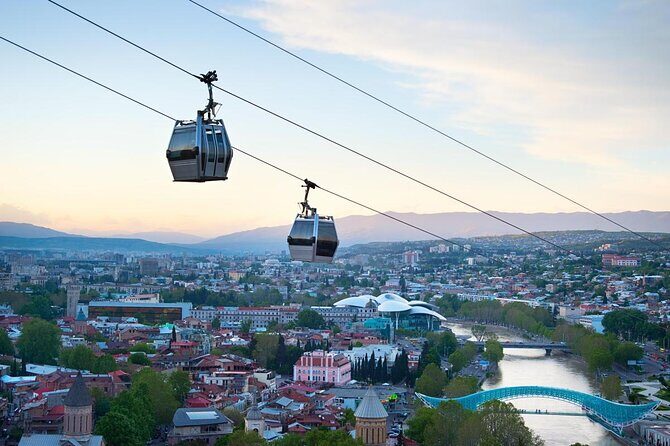
- Cable car ticket included: a direct lift to Narikala Fortress from the river-city side
- Golden angel puppet show detail: at Rezo Gabriadze’s theater, the clockwork angel appears hourly
- Peace Bridge design nerd candy: opened May 6, 2010, with known architect and lighting designer
- Rike Park Georgia silhouette map: a bird’s-eye layout of the country drawn into the pathways
- Sulfur bath district time: Abanotubani and Leghvtakhevi Waterfall give you Tbilisi’s famous bath energy
Value and flow: a 4-hour Tbilisi loop with the cable car
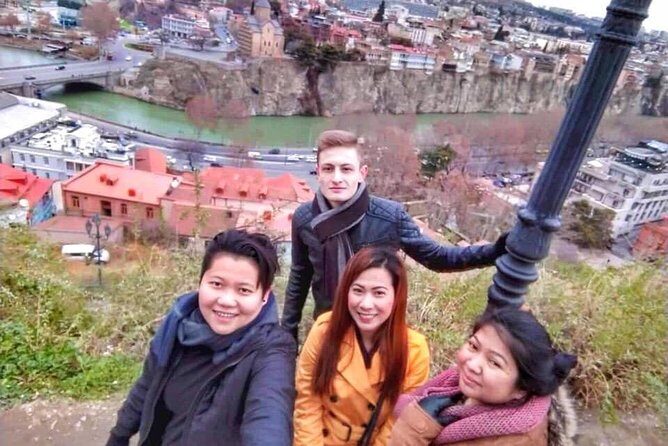
This tour is built like a good city walk should be: you get a clear route through the main “I can’t believe I’m here” sights, but you’re not stuck running from one paid ticket line to another. The price is $27.24 per person, and the value comes from two big things: most listed stops are free to enter, and the itinerary includes the cable car ride up toward Narikala.
You also get practical extras that make the day smoother: bottled water is included, and you travel with a local guide who can explain what you’re seeing in plain terms. The tour uses a mobile ticket, which is handy if you don’t want to deal with printed vouchers.
The main trade-off is physical. It’s about four hours of moving through old streets, courtyards, and viewpoints. If you’re the type who hates stairs, you’ll still be able to enjoy the ride via the included cable car—but you’ll want shoes with grip and a light layer, depending on the season.
You can also read our reviews of more walking tours in Tbilisi

Walls, puppets, and Anchiskhati: starting in Tbilisi’s medieval spine
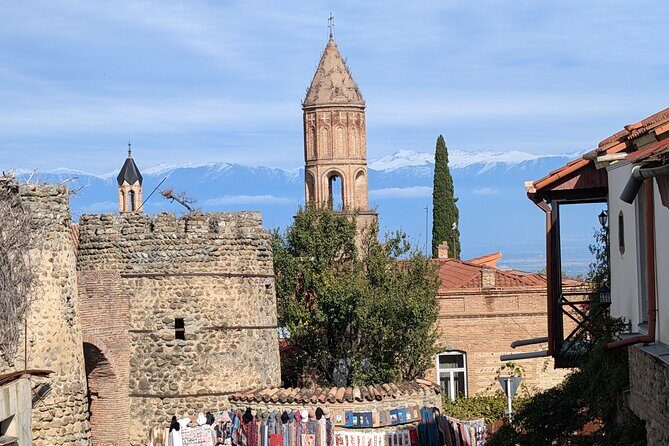
You kick off in the old core near the medieval layers of the city. The first stop is the Tbilisi Wall Ruins and underground heritage connected with the 11th-century Old Customs Gate area. Even if you’re not a “history museum” person, this kind of stop helps you understand why Tbilisi grew the way it did—walls, crossings, and the logic of defense.
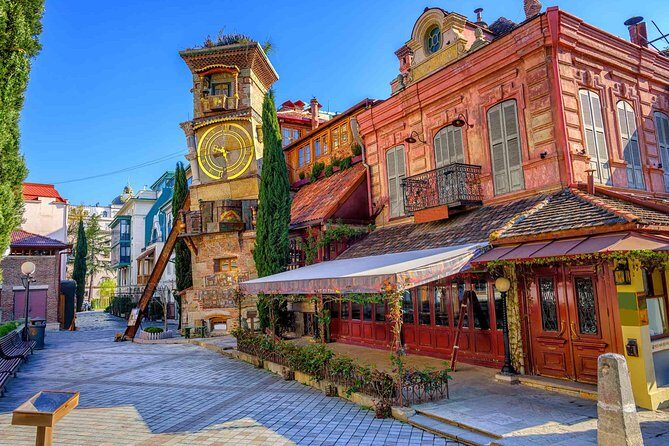
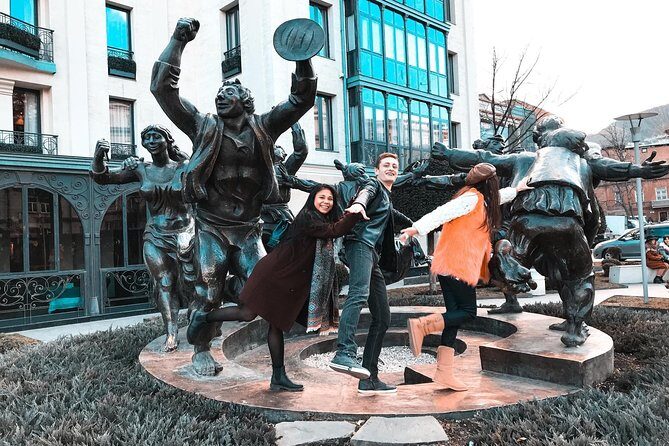
Next comes something very Tbilisi and very Georgian: Rezo Gabriadze Marionette Theater. The theater has distinctive architecture, built in 1981, and the clock tower detail created by Rezo Gabriadze is a signature moment. One hourly feature is especially memorable: a golden angel comes out of the painted doorway, rings the bell with a small hammer, and turns the building into a tiny stage machine.
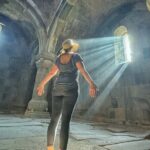
Then you head to Anchiskhati Basilica, a three-nave church dating back to the 6th century. It’s described as the oldest church building in Tbilisi, and the details connect religious art with Georgian identity. The name is linked to an icon of the Savior that arrived from Anchi Monastery in 1664, and that icon is noted as an example of Georgian carving craftsmanship, with the work attributed to Beka Opizari and preserved in the Georgian National Museum.
Quick tip: at these churches and historic buildings, be ready for short stops that still feel meaningful. You’ll get context fast, then move on—no long lectures.
Erekle II Square to the Bridge of Peace: where old meets new
After the medieval sights, the route shifts toward areas that show how modern Tbilisi “talks back” to the past. You pause at the Patriarchate of Georgia area on the edge of Erekle II Square. The site’s story is tied to earlier royal presence—there was a palace of King Rostom here—and the current building work began in 1809 on top of remnants connected to Tsarist-era structures. It’s a reminder that squares and institutions in Tbilisi often sit on top of earlier layers.
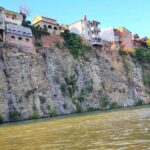
Then comes one of the city’s best-known modern icons: the Bridge of Peace. It connects Erekle II Street and Rike across the Mtkvari River, between the Metekhi and Baratashvili bridges. The bridge opened on May 6, 2010, and the information you’ll hear includes the architect Michele de Luca and the lighting designer Philippe Martino—useful because it explains why the bridge feels intentional rather than random modern decoration.
Next, you reach Rike Park, a newer park area that’s more than just a walk space. From above, the park’s layout forms a large-scale map of Georgia, and the meandering pathways reference different regions of the country. It’s a visual lesson in geography without any textbook—especially satisfying if you’re still learning where things are.
If you hate “photo-only stops”: this section works because the bridge and park are tied to design choices you can spot in person.
Metekhi Cathedral, King Vakhtang, and the Narikala cable car ride
Old Tbilisi keeps climbing—both literally and spiritually. At Metekhi Cathedral, you’re focused on a specific sacred story: the tomb of St. Shushanik is noted as the main sanctuary. After an ecclesiastical split in the early 7th century, Catholicos Kyrion transferred the saint’s remains from Tsurtavi to the Metekhi temple. The details also mention Queen Tamar adorning the saint’s body with gilded clothes and paying special homage.
From there, you step to the Monument of King Vakhtang Gorgasali. This statue anchors the route in the story of Vakhtang I Gorgasali, a king of Iberia (Kartli) in the 5th–6th century era. His alliance with the Byzantine Empire and the struggle against Sasanian Iranian hegemony are part of what you’ll hear, even if you only take away one sentence: Tbilisi’s geography is tied to power struggles far beyond the city limits.
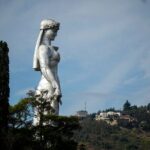
Then you’ll see Kartlis Deda (Mother of Kartli)—a huge city symbol often remembered for the contrasting hands. The statue holds a wine glass for guests and a sword for enemies. It’s a simple message, but it matches the overall vibe of Tbilisi: hospitality and grit in the same frame.
The highlight for many people is the included Aerial Tramway. The cable car links the Rike Park / Europe Square side to the fortress of Narikala. This matters because it makes the route feel smart: you get the viewpoint value without paying extra for transportation.
Narikala Fortress and Juma Mosque: one hill, different worlds
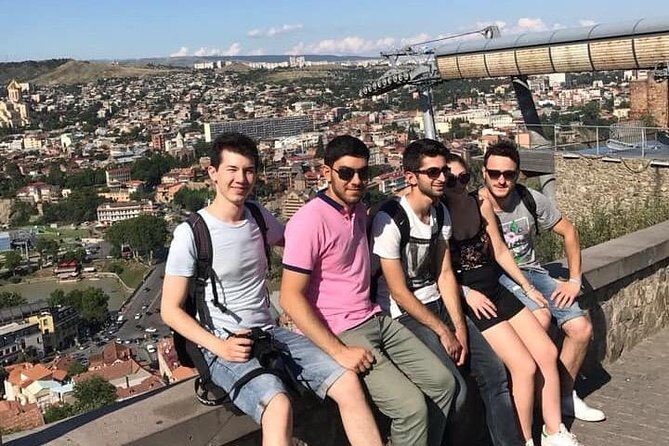
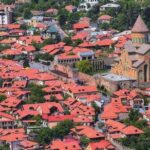
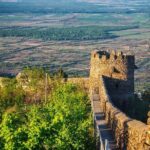
Once you’re up, Narikala Fortress is the big payoff. The fortress fragments are described as dating to the 4th century AD, with later expansions through multiple eras. The notes also mention that Arabs did work in the 7th–8th centuries, and that the citadel in modern condition is an example of Arabian fortification.
You’ll also hear about the fortress interior, including St. Nicolas temple dated to the 12th century. This is a good section for slowing down, because fortress areas tend to give you both architecture and a wide sense of place. Even during short visits, you get that feeling that Tbilisi began as a stronghold idea, not a random settlement.
Below Narikala, you can also take in Tbilisi’s Juma Mosque (the only Muslim shrine in the city, as described). The mosque story is long and layered: the first Sunni mosque is listed as built by Ottomans between 1723–1735, destroyed in the 1740s, rebuilt in 1846–1851 by architect Giovanni Scudieri, and then fully renovated in 1895 (with the eastern part changed) by Hajizinelabdin Tagiyev.
Practical mindset: you’re not just checking boxes here. You’re seeing how one hill holds defense, worship, and community memory in different forms.
You can also read our reviews of more food & drink experiences in Tbilisi

Leghvtakhevi Waterfall and Abanotubani: sulfur steam energy

From Narikala’s heights, the route drops back into the atmospheric old-city bath district. First is Leghvtakhevi Waterfall, described as 22 meters tall. The name comes from a Georgian word linked to fig trees, and you’ll hear the area was once surrounded by fig trees. The gorge is part of the reason this spot feels like an old city world of its own.
Then you arrive at Abanotubani, the sulfur bath district at the foot of Narikala. The emergence of the baths is tied to hot sulfur springs, and the baths are noted as built in different times across roughly the 17th–19th centuries. The oldest bath mentioned is the Irakli bath, which has a story about disputes between imperial family interests and Georgian princes in the 16th century.
This section is where Tbilisi stops feeling like a photo checklist and starts feeling like a living neighborhood. Even if you don’t plan to go into a bath, just seeing the district gives you context for why locals treat this area as part of everyday city life.
A related stop is Chreli Abano, described as a sulfur bath popular with tourists and Georgians. It’s noted that the site looks like a mosque, but it’s a sulfur bath—so you get a little culture-contrast right away.
If you want to do something extra: you may want to bring a cover-up or plan what you’ll do in the district, since this is the part of town where you’re most likely to be tempted to add a bath stop.
Meidan Bazaar, Shardeni Street, and Sioni Cathedral

After the bath district, the day shifts toward commerce and public life—Tbilisi’s social center. Meidan Bazaar is a key stop. It’s described as always having been a commercial square, even under different names in the past. The info also notes that French traveler Jean Sharden mentioned it in the 18th century.
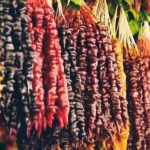
This is the moment where the wine-tasting angle fits naturally. The market area is specifically described as a place to buy traditional Georgian wine, alongside accessories, souvenirs, and delicacies. Since food and drinks aren’t included on the tour, treat this like your best chance to pick up something to bring home or to taste on your own schedule in the area.
From Meidan, you head to Jan Shardeni Street, a pedestrian street that’s one of the city’s social and cultural centers. After reconstruction in the 19th century, the street got its name in honor of Jean Chardin. The walk is lined with galleries and cafés, and you can use the time for a relaxed stroll rather than another quick “look and move” stop.
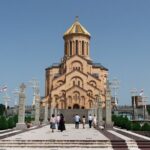
The tour ends with Sioni Cathedral Church, the Assumption of the Blessed Virgin Mary. It’s described as a cross-domed temple from the 5th century, and in modern times it’s noted as the Patriarchal Cathedral since 1920. If you’ve been following the route from medieval gates and old churches up to this point, Sioni feels like the final “anchor” where the religious thread ties together.
My take on the pacing: you finish with a strong, iconic building instead of a random street corner. That’s good tour design.
Should you book this friendly Tbilisi walking tour?

Book it if you want a structured, friendly way to see both classic old Tbilisi and the highlights with modern design. The inclusion of the Narikala cable car is a smart value move, and the route covers big emotional stops: fortress views, sulfur-bath atmosphere, and a mix of churches that explain why Tbilisi’s identity is both layered and local.
Skip or rethink if you have mobility limits with stairs and steep ground. The day is only about four hours, but it’s still built around historic areas where the terrain isn’t flat.
One more decision factor: you’ll likely enjoy this more if you like getting context from your guide. This tour’s vibe is described as close and warm, and one guide name that comes up is Anastasia (Fellini Travels)—praised for being friendly and making the walk feel easy.
FAQ
FAQ
How long is the walking tour?
The tour is listed at about 4 hours.
What does it cost?
The price is $27.24 per person.
What’s included in the tour price?
The included items are bottled water and a local guide. The cable car portion is also listed as included.
Is the cable car ticket included?
Yes. The aerial tramway is marked as admission ticket included.
Are the stops with churches and landmarks free to enter?
In the itinerary details, the stops are shown with admission ticket free.
What’s not included?
Food and drinks are not included. Hotel pickup and drop-off are also listed as not included.
Where does the tour start and end?
It starts at Tbilisi Pushkin Square and ends near Orbeliani Bazaar (Площадь Орбелиани).
What size is the group?
It’s described as a small-group tour with a maximum of 15 people.
Can kids join?
Children must be accompanied by an adult.
What is the cancellation policy?
You can cancel for a full refund up to 24 hours in advance. Free cancellation is offered, with local-time cutoffs.