REVIEW · TBILISI
Private Walking Tbilisi City Tour (Day Trip)
Book on Viator →Operated by Individual Entrepreneur Vazha Gakharia · Bookable on Viator
Tbilisi rewards people who walk with purpose. This day-long city walk strings together old-town fort views, multi-faith landmarks, and a few modern Tbilisi stops so you understand the capital instead of just collecting photos.
I like that you get a real guide with English commentary, plus bottled water in the day’s heat. I also like the mix of faiths and eras—Christian churches, a historic synagogue, and the sulfur-bath legend all on one route. One thing to consider: you’re walking for hours and transportation isn’t included, so plan how you’ll reach the start point and keep comfortable shoes ready.
If your goal is to get context fast, this tour is built for that. It’s a full-day loop with clear stopping points, most of them free to enter, and one paid highlight where you’ll get the ticket taken care of. You might find it best as a first visit to Tbilisi, when you want a guided map of the city in your head.
In This Review
- Key things I’d circle before you go
- A 6–7 hour loop that connects Tbilisi’s stories
- Price and value: $59 for a guided day with real coverage
- Before you go: how to make this walk comfortable
- Narikala Fortress: the skyline start with anchors from the 6th century
- Sulfur Bath 5 and the Metekhi plateau: learning Tbilisi from its warm-water legend
- Rustaveli Avenue: a shift from fort walls to the city’s modern spine
- Abanotubani: the old-town bathing heart (and why it keeps showing up)
- Great Synagogue of Tbilisi and Metekhi Cathedral: two faith landmarks in one flow
- Bridge of Peace, Rike Park, and Kartlis Deda: modern design with a Georgian face
- Anchiskhati Basilica and Sioni Cathedral: the early church story, rebuilt through trouble
- Leselidze, Rezo Gabriadze Marionette Theater, and Leghvtakhevi waterfall
- Who this tour is best for
- Should you book the Private Walking Tbilisi City Tour?
- FAQ
- How long is the Tbilisi city walking tour?
- What is included in the $59 price?
- Do I need to arrange transportation to the meeting point?
- Is the tour offered in English?
- What religious and cultural landmarks will I see?
- What happens if weather is bad?
Key things I’d circle before you go
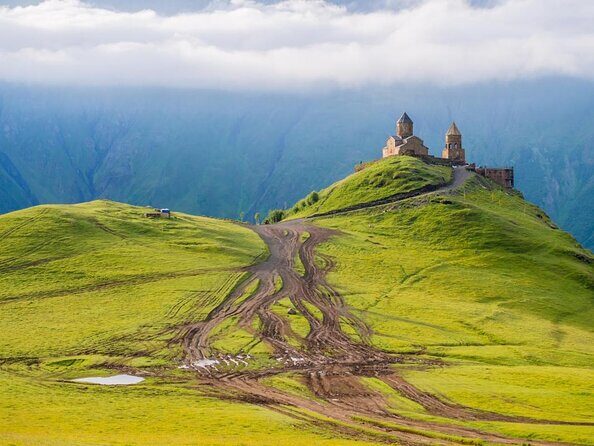
- Multi-faith Tbilisi in one day: Jumah Mosque, Great Synagogue, and major Orthodox churches along the same route
- Narikala Fortress ticket included: you start strong with the Old Tbilisi skyline
- Sulfur Bath area tie-in: learn why Tbilisi literally means warm water
- Bridge of Peace + Rike Park: modern design and local festival vibes in the same afternoon
- Rezo Gabriadze Marionette Theater stop: a quick look at one of Tbilisi’s most recognizable cultural spots
- Professional English guide + bottled water: practical support for a long day of walking
A 6–7 hour loop that connects Tbilisi’s stories
This is a shared walking tour designed to move you through Tbilisi’s major layers without making you plan your own route. The day is roughly 6 to 7 hours, and it’s offered in English with a professional guide. You also get complimentary bottled water for each participant, which sounds small until you’re halfway up a hill in warm weather.
Tbilisi’s best trick is that it changes mood every few blocks. You’ll start with fortified viewpoints, slip into the sulfur-bath zone, then drift across the modern city with wide avenues and major theaters. The route keeps your orientation simple: you see the city’s landmarks in a logical flow, and you learn what they mean along the way.
You can also read our reviews of more walking tours in Tbilisi


Price and value: $59 for a guided day with real coverage
At $59 per person, I treat this as a value play because you’re paying for time and guidance, not just “stops.” You get:
- a professional guide
- bottled water
- an itinerary that covers major historical points in Old Tbilisi and a few key newer-city landmarks
What you don’t get is transportation, and that’s worth noting. Since the tour ends back at the meeting point, the smartest way to use the pricing is to show up already positioned near central Tbilisi. If you’re staying close to the Old Town/central areas, the cost makes more sense because you avoid extra taxi time and it becomes a pure walking day.
Also, this tour can be popular—on average it’s booked about 26 days in advance, so I’d secure your date early if you’re traveling during peak season.
Before you go: how to make this walk comfortable
Because transportation isn’t included, the biggest practical decision is footwear and meeting-point logistics. This is a walking itinerary with short stops—some are only 10 to 15 minutes—so you’ll want shoes that handle uneven sidewalks and hills.
A few other practical notes based on the tour info:
- You’ll receive a mobile ticket
- The tour runs in English
- It works for most travelers
- The group limit is up to 100 travelers, so expect a lively group pace rather than a quiet private promenade
And because it’s described as requiring good weather, bring a plan for rain. If it gets canceled for poor weather, you’ll be offered a different date or a full refund.
Narikala Fortress: the skyline start with anchors from the 6th century
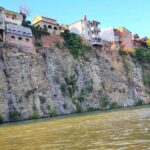
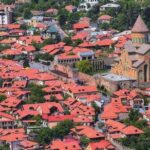
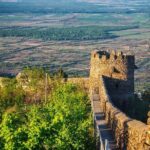
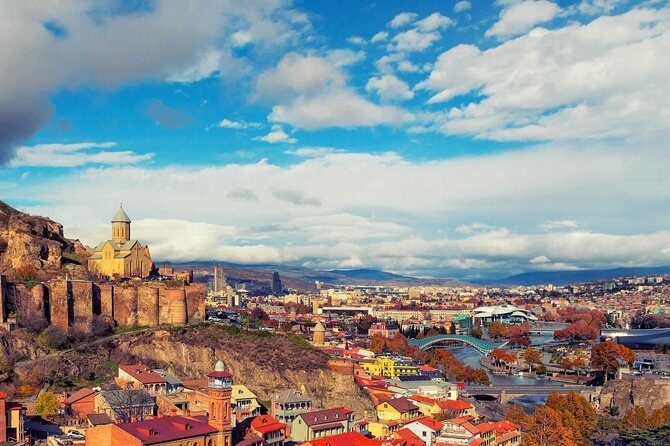
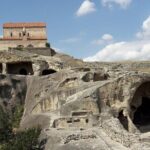
Your tour kicks off around Narikala Fortress, the kind of place where you immediately understand why cities grow where they do. Expect views of typical Tbilisi houses with balconies and the fortress perspective over Old Tbilisi.
This is also where the day’s time depth starts to stack up:
- Anchiskhati Church (6th century) is located in this area
- The Holy Trinity Cathedral is nearby (the tour route passes through the neighborhood context)
- You’ll also hear about other faith and cultural layers around the same high ground, including Catholic and Gregorian churches, plus the Muslim mosque presence and the synagogue in the broader area
- The area is also tied to Ateshga, described as a temple of pagans
There’s a built-in efficiency here: you don’t just see the fortress. You get the “why it matters” part—how Old Tbilisi developed inside and around its wall, and how today’s skyline grew from that fortified shape.
Tour time here: about 50 minutes, and the Narikala Fortress admission ticket is included.
Sulfur Bath 5 and the Metekhi plateau: learning Tbilisi from its warm-water legend
After Narikala, you step down toward the area connected to the story behind the city’s name. The guide ties it to legend and language—King Vakhtang Gorgasali (in the 4th century, per the tour description) and the idea that the word “tbili” relates to warm water.
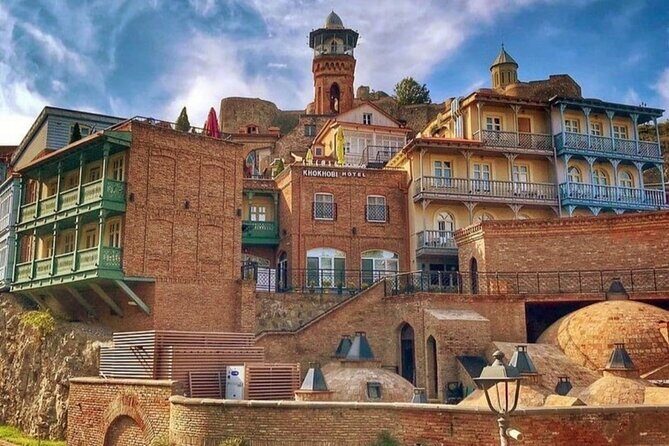
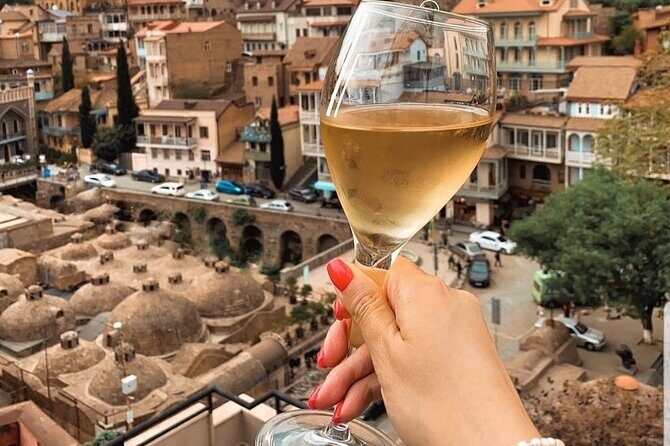
You’ll stop at Sulfur Bath 5, near the Metekhi plateau, where you’ll get context on the famous hot-springs culture that still defines the Old Town experience. This is one of those stops that changes the way you look at Tbilisi. After you hear the legend and the language connection, the baths become more than a quirky attraction—they become part of the city’s identity.
Tour time here: about 30 minutes. The tour lists admission as free for this stop.
You can also read our reviews of more city tours in Tbilisi



Rustaveli Avenue: a shift from fort walls to the city’s modern spine
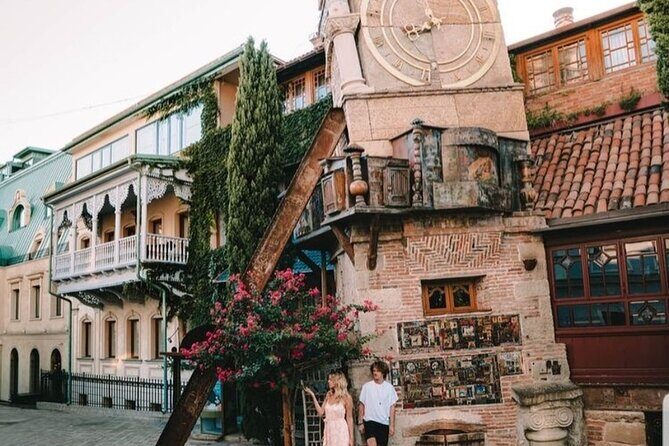
Next you’ll cross into Tbilisi’s newer-city energy at Rustaveli Avenue. This is where the capital looks deliberate and planned, not just layered by centuries.
You’ll see major institutions and cultural landmarks mentioned on the route:
- the Drama Theater named after Rustaveli
- the State Academic Theater of Opera and Ballet named after Zakaria Paliashvili
- art salons and educational buildings (like the first gymnasium)
This part of the tour helps you balance what you’ve just learned in Old Tbilisi. It’s also a useful mental reset: you get to stretch, walk on broader streets, and absorb how Tbilisi functions beyond the historic core.
Tour time here: about 1 hour.
Abanotubani: the old-town bathing heart (and why it keeps showing up)
You’ll then head into Abanotubani, described as an important historic district and tied to the discovery story of hot springs—again connected to King Vakhtang Gorgasali’s falcon (and the legend that leads to founding the new capital).
This stop is short, but it matters because it’s where you start noticing the physical character of Tbilisi: the way the baths cluster, and how the neighborhood feels like it was designed to support a routine, not just a sight.
You’ll spend time here close to the old-town core, with enough minutes to take photos and match what you’ve learned to what you see.
Tour time here: about 15 minutes. Admission is listed as free.
Great Synagogue of Tbilisi and Metekhi Cathedral: two faith landmarks in one flow
This tour doesn’t treat Tbilisi’s religious heritage like a checklist. It puts key sites near each other so you can understand how different communities shaped the city’s center.
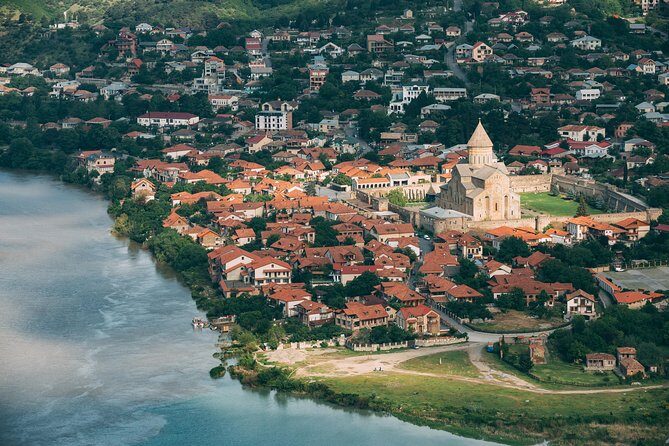
First, you’ll stop at the Great Synagogue of Tbilisi (also called the Georgian Synagogue). It was built between 1895 and 1903 in an eclectic style by Georgian Jews from Akhaltsikhe, which is why it’s sometimes called the synagogue of the people of Akhaltsikhe.
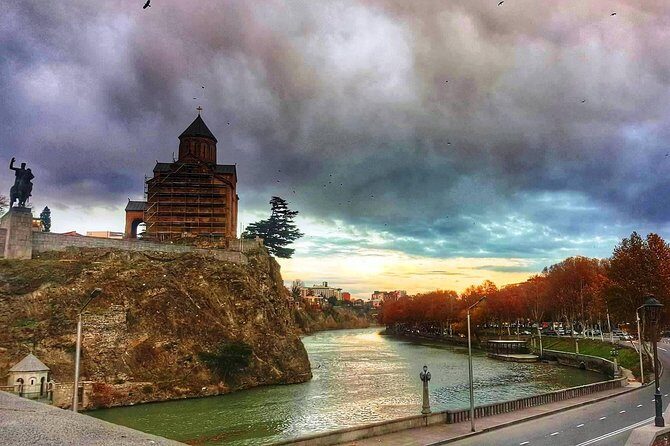
Then the route brings you to Metekhi Cathedral. The tour description emphasizes King Vakhtang I Gorgasali and the idea that a church and fort served as a royal residence. The name “Metekhi” dates to the 12th century and relates to the palace area.
I like pairing these two stops because they show Tbilisi’s “together-but-separate” urban pattern. From the outside, they don’t look like they belong to the same city story—yet here they are, close enough to see how the capital grew multi-directionally.
Tour time: about 15 minutes at the synagogue (free) and about 15 minutes at Metekhi Cathedral (free).
Bridge of Peace, Rike Park, and Kartlis Deda: modern design with a Georgian face
After the religious stops, you’ll move into a more modern Tbilisi vibe with three iconic points that are still rooted in local symbolism.
You’ll cross the Bridge of Peace, constructed in 2009–2010 and designed by Italian architect Micele De Luci, with a French lighting system referenced as Philip Martino. Even if you only get a short look, this bridge is a quick lesson in how Tbilisi modernized without abandoning the river-and-view logic.
Then it’s Rike Park, where local festivals like Tbilisoba are held. This makes the park feel like a living part of the city, not just a green space for photos.
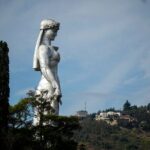
Finally, you’ll see Kartlis Deda, described as a Georgia symbol who meets friends with wine and enemies with sword. It’s the kind of statue that’s easy to remember because it’s narrative-driven, not abstract.
These stops are short, but they help you close the loop between Old Town meaning and modern city expression.
Tour time: about 15 minutes for Bridge of Peace (free), 15 minutes for Rike Park (free), and 15 minutes for Kartlis Deda (free).
Anchiskhati Basilica and Sioni Cathedral: the early church story, rebuilt through trouble
Now we get to two major Orthodox anchors, each with a different angle on time.
At Anchiskhati Basilica, the tour description calls it the oldest of survived churches in Georgia, tied to the 6th century. It also mentions a specific artistic connection: an art studio connected to sculptor Elguja Amashukeli, who created the symbol of Georgia Kartlis Deda.
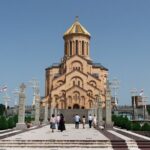
Then you’ll reach Sioni Cathedral. The tour description is clear that it’s older than the current building: it was built in the 6th and 7th centuries, then destroyed by foreign invaders and reconstructed multiple times. The current version is based on a 13th-century structure with changes through the 17th to 19th centuries. It also notes Sioni’s role as the main Georgian Orthodox Cathedral and seat of the Catholicos-Patriarch of All Georgia until Holy Trinity Cathedral was consecrated.
I like that this tour doesn’t skip the complicated part. Religious landmarks are often treated like museum pieces. Here, you hear how they were rebuilt, how power shifted, and how the city’s spiritual center moved across centuries.
Tour time: about 15 minutes at Anchiskhati (free) and about 15 minutes at Sioni Cathedral (free).
Leselidze, Rezo Gabriadze Marionette Theater, and Leghvtakhevi waterfall
The later part of the walk gives you variety so the day doesn’t feel like only churches and viewpoints.
You’ll pass Leselidze, a street described as combining old and new parts of the city. Think of it as a quick visual reminder that Tbilisi hasn’t stopped evolving just because it has ancient sites.
Then you’ll stop at the Rezo Gabriadze Marionette Theater. This is one of Tbilisi’s most recognizable cultural stops. The tour description says daily shows draw many tourists, and it describes the puppet theater as popular worldwide for its depth and soul. Even if you don’t sit down for a performance, the stop helps you see Tbilisi as a creative city, not only a historical one.
Finally, you’ll reach the Dzveli Tbilisi Sulphur Waterfall, also called Leghvtakhevi, listed as 22 meters tall. The name is tied to Georgian language and local detail: “Leghvi” means fig, and the area once had many fig trees around it.
This is a great closing trio because it transitions from solemn to playful and then to scenic. It also gives you a final burst of “wow, Tbilisi does weird things in a way that works.”
Tour time: about 15 minutes at Leselidze (free), about 10 minutes at the Marionette Theater (free), and about 20 minutes at Dzveli Tbilisi Sulphur Waterfall (free).
Who this tour is best for
This walking tour fits best if you want:
- a first-time orientation to Tbilisi
- a guide-led route that connects Old Tbilisi sights with a few modern landmarks
- a multi-faith perspective, not just one religious tradition
- a day that includes both major “must-sees” and a couple of personality-driven stops like the marionette theater and sulfur waterfall
It’s less ideal if you want private pacing, because it’s shared and up to 100 travelers. If you hate walking and rely on frequent stops with long rest breaks, you may find the schedule tight since many stops are intentionally short.
One more practical note: the guide experience seems to matter a lot here. Names like Teimuraz and Temo appear in past group experiences tied to strong storytelling and attentiveness, so if your guide happens to be one of them, you’ll likely get extra detail and clear explanations.
Should you book the Private Walking Tbilisi City Tour?
I’d book this tour if you’re visiting Tbilisi for the first time and you want to leave with a mental map of the city. For $59, you’re paying for a full-day guided loop that covers fort views, major churches, a historic synagogue, and the sulfur-bath legend—plus bottled water to keep you moving.
I wouldn’t book it if you need transportation included or if you’re struggling with long walking days. Also, since the tour requires good weather, plan to be flexible with your schedule.
If your trip style is walk, learn, and connect the dots, this is a solid way to do Tbilisi without getting lost in it.
FAQ
How long is the Tbilisi city walking tour?
The tour lasts about 6 to 7 hours.
What is included in the $59 price?
You get a professional guide service and bottled water. The tour also includes a ticket for Narikala Fortress; other stops are listed as free admission.
Do I need to arrange transportation to the meeting point?
Yes. Transportation is not included, and the tour ends back at the meeting point.
Is the tour offered in English?
Yes. The tour is offered in English.
What religious and cultural landmarks will I see?
You’ll see major sights tied to Christian heritage, including key churches, plus Jumah Mosque and the Great Synagogue of Tbilisi.
What happens if weather is bad?
This tour requires good weather. If it’s canceled due to poor weather, you’ll be offered a different date or a full refund.