REVIEW · TBILISI
Full Day Tbilisi City Tour with Wine Tasting & Cable Car Ride
Book on Viator →Operated by SelectGeorgia-For Holiday · Bookable on Viator
Tbilisi in one day: a smart move. You get a full sweep of the city’s big sights, plus wine tasting and major viewpoint rides that help you understand where everything sits. I like the private driver setup and the way the route mixes churches, fort views, and photo stops without turning the day into a sprint. One possible drawback: the day includes a lot of walking and stairs in Old Town, and the funicular ride is extra—so budget time and a little cash for the add-ons.
This tour is best if you want a clear first-pass orientation. You’ll leave knowing the main landmarks, how Tbilisi’s culture layers on top of each other, and where the viewpoints are for your next independent wander.
In This Review
- Key highlights and what to expect
- How the 9-hour Tbilisi day actually feels (and what you pay for)
- Chronicles of Georgia: the dramatic memorial with Christ-and-Queen symbolism
- Holy Trinity Cathedral: modern scale with an autocephaly message
- Mtatsminda funicular vs included cable car: choose your views wisely
- Mother of Kartli and Narikala Fortress: fortress views with national symbolism
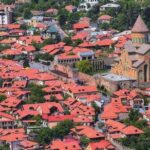
- Old Town Tbilisi: architectural layering along the Kura
- Metekhi Cathedral: medieval church, then Russian and Soviet chapters
- Sulphur baths area and Leghvtakhevi waterfall: heat, water, and a quick reset
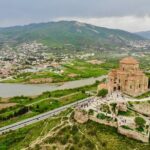
- Sioni Cathedral and Jvaris Mama (Father of Cross): Jerusalem connections in Tbilisi
- Rezo Gabriadze Puppet Theater and Anchiskhati Basilica: quirky modern art in an ancient city
- Bridge of Peace and the Rike area: modern design plus folk music
- Value check: is $147.50 a fair deal for this mix?
- Practical tips to make the day smoother
- Should you book this Tbilisi city tour?
- FAQ
- FAQ
- What time does the tour start and how long does it last?
- Is pickup included?
- Is the tour conducted in English?
- What rides are included, and what costs extra?
- Is wine tasting included?
- Is lunch included in the price?
- Do I pay admission for the churches and key sights?
- What should I wear for Orthodox churches?
- Can the tour accommodate dietary restrictions?
Key highlights and what to expect
- Wine tasting with a Georgian meal stop built into the day, so you’re not just sightseeing for show
- Mother of Kartli + Narikala viewpoints via a cable car segment included in the price
- Old Town walking time with plenty of free-to-enter major churches and landmarks
- A mix of eras—from medieval churches to Soviet-era memorials and modern bridges
- Attire matters at Orthodox churches: bring or plan to get a headscarf and longer coverage
How the 9-hour Tbilisi day actually feels (and what you pay for)
The tour starts at 9:00 am and runs about 9 hours, with a private driver and an air-conditioned vehicle between stops. That matters more than it sounds. Tbilisi’s sights are spread out, and Old Town includes hills and uneven ground—so having transport lined up keeps your day from turning into tired taxi math.
The price is $147.50 per person, which is fairly strong value for a full route that strings together many major sites with minimal friction. You also get bottled water, and alcoholic beverages are part of the inclusions—just remember Georgia’s legal drinking age is 18. Wine tasting is included, and that’s the right kind of “activity” for a one-day plan: it’s memorable, social, and tied to local culture.
One small thing to watch: the day includes a lunch stop, but the pricing notes list lunch under not included. Translation: expect to eat as part of the schedule, but confirm what’s covered in the cost versus what you’ll pay at the restaurant. Also, the funicular ride to Mtatsminda Park is not included (listed around $7 per person).
You can also read our reviews of more food & drink experiences in Tbilisi


Chronicles of Georgia: the dramatic memorial with Christ-and-Queen symbolism
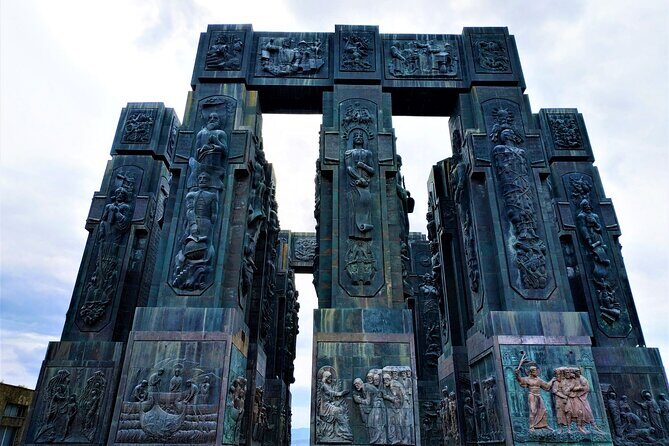
The day begins with the Chronicles of Georgia memorial, a big, visual history lesson built as a series of 16 tall pillars (about 30–35 m each). The top halves depict kings, queens, and heroes, while the lower parts connect the storytelling to scenes from the life of Christ. There’s also a grapevine cross connected with St. Nino and a chapel, so even if you’re not a “monument person,” there’s plenty to look at.
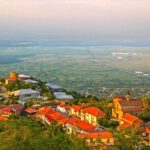
What I like here is the payoff: you’re not just reading plaques. The site sits high and gives great views over the Tbilisi Sea area, which helps you map the city in your head quickly. Entry here is listed as free, and the time on site is about 30 minutes, enough for photos without forcing you to linger.
Consideration: because it’s a viewpoint-style stop, the day’s quality depends on weather and light. If it’s foggy or rainy, you’ll still get the monument details, but the views may feel muted.
Holy Trinity Cathedral: modern scale with an autocephaly message
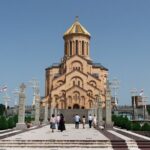
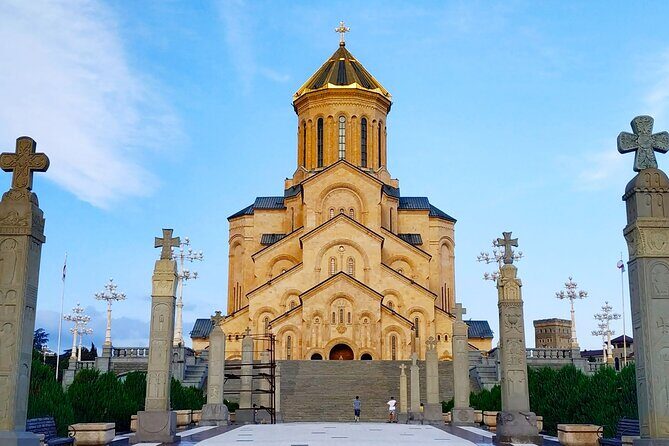
Next up is Tbilisi Holy Trinity Cathedral, the main cathedral of the Georgian Orthodox Church (built 1995–2004). It’s described as the third-tallest Eastern Orthodox cathedral and among the largest in the world by total area. The reason it was built is part of the story: it commemorates 1,500 years of autocephaly of the Georgian Orthodox Church and 2,000 years from the birth of Jesus.
The practical win is the timing: you’re given about 40 minutes, which is enough to step inside, take in the scale, and not feel rushed. Admission is free. Like many Orthodox churches, you should plan to dress with respect—especially since the tour notes specify that ladies need head scarves and dresses, and men can’t wear short trousers. Scarves and appropriate clothing are said to be available near church entrances.
Consideration: the cathedral is large. If you’re sensitive to crowds or want quiet time, plan to focus on one section at a time rather than trying to absorb everything at once.
Mtatsminda funicular vs included cable car: choose your views wisely
Tbilisi has more than one “ride up.” First, you’ll head toward Mtatsminda Park, the highest point of the city at 770 meters. The funicular ride is listed as not included and is around $7. The funicular road is 501 m, with an angled tunnel section (about 28–33°). If you love skyline views, this is a good place to spend that extra money because the city looks different from above.
Later in the day, you get a second viewpoint ride that is included: an aerial tramway segment. This takes you toward the Mother of Kartli monument and then connects onward to the Narikala Fortress area.
Here’s why that pairing works: Mtatsminda can give you one kind of panoramic feel, while Narikala gives you the “historic fortress over the old streets” effect. Both are photo-heavy, and both help you understand Tbilisi’s geography fast.
Mother of Kartli and Narikala Fortress: fortress views with national symbolism
The Mother of Kartli monument was erected in 1958, tied to Tbilisi’s 1500th anniversary. The sculptor Elguja Amashukeli designed the aluminum figure—about 20 meters tall—showing a woman in national dress. The symbolism is specific: her left hand holds a bowl of wine to greet friends, and her right hand holds a sword for enemies.
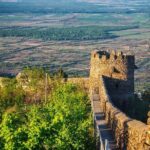
Then it’s onward to Narikala Fortress. The fortification story goes back much farther than the current ruins: it was established in the 4th century as a Sasanian citadel called Shuris-tsikhe, and later expanded by King David the Builder (1089–1125). The Mongols renamed it Narin Qala, meaning Little Fortress. Most extant fortifications are from the 16th–17th centuries, and an earthquake in 1827 caused damage.
What you’ll really notice up here is the mix of time. From the viewpoint, it’s easy to see why empires argued over this area. You can look down and understand how control and trade routes mattered.
Admission for this segment is listed as included for the Narikala area after the cable car portion, and the time allocation is about 30 minutes.
Consideration: this is one of the stops where you’ll feel the effect of walking pace. If you want slow photography and time for the perfect angle, keep an eye on the clock.
You can also read our reviews of more city tours in Tbilisi


Old Town Tbilisi: architectural layering along the Kura
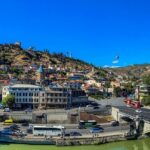
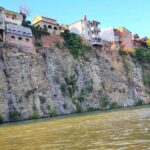
Old Town takes the longest block—about 3 hours—and that’s where the city turns from “landmarks on paper” into lived-in streets. Tbilisi sits on the banks of the Kura River and was founded in the 5th century AD by Vakhtang I. Its location at a crossroads between Europe and Asia made it a place where powers fought and cultures mixed.
You’ll see that layering in the architecture, which spans medieval, neoclassical, Beaux Arts, Art Nouveau, Stalinist, and modern buildings. It’s a lot to process in one day, but that’s also the point. Old Town here isn’t a museum—it’s a working neighborhood.
Expect plenty of free entry sights within this walking time, and expect terrain. The tour notes flag stairs and uneven ground. That’s why comfortable shoes matter. If you go in dressed for fashion over traction, you’ll feel it by early afternoon.
Metekhi Cathedral: medieval church, then Russian and Soviet chapters
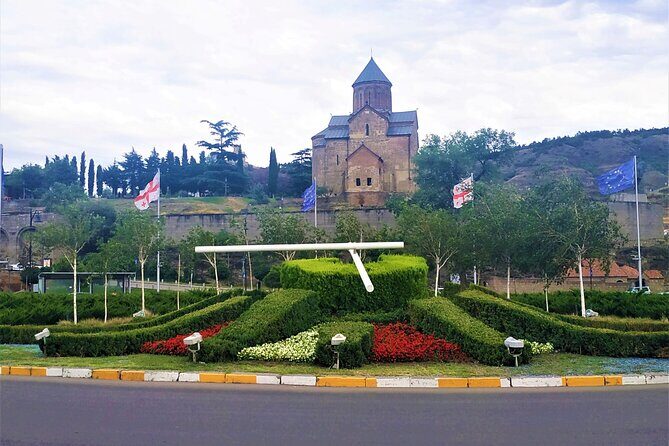
At Metekhi Cathedral (Church of Assumption), the story is layered like a timeline you can’t scroll past. The church was built by Georgian king St Demetrius II (around 1278–1284). It was later damaged and restored multiple times. Under Russian rule (starting in 1801), the church lost its religious purpose and was used as a soldier base.
The citadel was demolished in 1819, replaced by a jail that lasted through the Soviet era, and the jail closed in 1938. A statue of King Vakhtang Gorgasali by sculptor Elguja Amashukeli was erected in 1961.
This stop is about 30 minutes and is listed as free. The payoff is that you get a sense of how the same place can serve completely different roles depending on who’s in power.
Consideration: because it’s a history-heavy stop, you’ll enjoy it most if you ask your guide a question or two about what changed over time.
Sulphur baths area and Leghvtakhevi waterfall: heat, water, and a quick reset
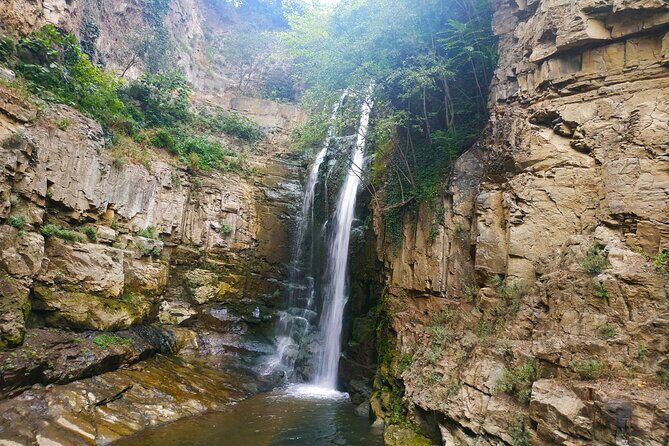
After the fortress viewpoint, the day drops into something more sensory: Dzveli Tbilisi Sulphur Waterfall and the surrounding area near Leghvtakhevi. You’ll visit sulphur baths and the waterfall, plus the Love Lock Bridge.
The sulphur baths are described as thermal springs rising from the ground, with temperatures around 40–50°C. The notes list possible benefits like skin issues, dry scalp, arthritic joints, digestion problems, and insomnia. I’d still treat that as “common claims,” not medical advice, and think of this as a cultural stop where you see a signature element of Tbilisi life.
The waterfall is described as flowing from a botanical garden. This is one of those stops where you might not need long time, because the visual and sound effects hit fast. The time listed is about 20 minutes, and admission is listed as free.
Consideration: if the day is hot, this area can feel sticky or crowded. If it’s raining, the waterfall might look dramatic—but paths could get slippery.
Sioni Cathedral and Jvaris Mama (Father of Cross): Jerusalem connections in Tbilisi
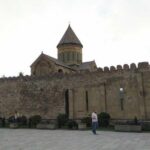
Next you’ll reach Sioni Cathedral Church, tied to Mount Zion in Jerusalem. The cathedral dates back to the 6th–7th centuries in early form, though it was destroyed by foreign invaders and rebuilt several times. The current church is based on a 13th-century version with later changes from the 17th–19th centuries, and it was completely rebuilt by King David the Builder in 1112.
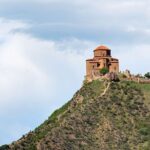
Then the tour adds Jvaris Mama Church (also called the Saint Cross church / Father of Cross). The legend link is strong: King Vakhtang Gorgasali built a saint cross church in the 5th century, and St. Nino is said to have lived there. The present building is 16th century with destruction and restoration cycles, and it was restored in the 1990s. The notes even add a practical oddity: it’s described as cold, which points to its story as the Father of Cross.
This section is about 20 minutes after Sioni, with admission listed as free.
Consideration: dress rules still apply here. If you’ve already sorted your scarf and coverage earlier, you’ll coast through this part.
Rezo Gabriadze Puppet Theater and Anchiskhati Basilica: quirky modern art in an ancient city
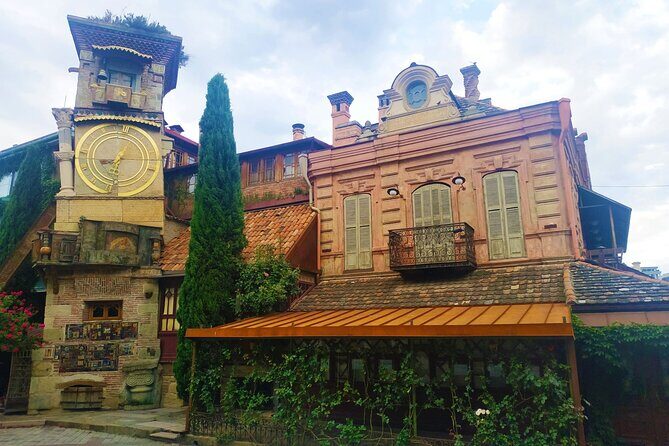
One of the more fun segments is the stop around Leselidze Street, including the Tamada statue and Rezo Gabriadze Puppet Theater. Rezo Gabriadze was a theatre and film director, writer, painter, and sculptor, and the theatre he founded opened in 1981. A clock tower was added in 2011, and there’s a specific mechanism: on the hour, a window opens and a mannequin of an angel strikes the bell. Below it, a screen opens and shows the circle of life—boy meets girl, marriage, childbirth, and funeral.
That’s a delightful contrast after the heavy theology and fortress history. It reminds you that Tbilisi doesn’t only care about stone and emperors—it also cares about art and storytelling.
Then you’ll head to Anchiskhati Basilica of St Mary, listed as the oldest surviving church in Tbilisi (dated to the 6th century). It was originally dedicated to the Virgin Mary and renamed Anchiskhati in 1675, linked to the movement of a treasured icon created by a 12th-century goldsmith, Beka Opizari. The icon was moved to Tbilisi to protect it from Ottoman invasion, and it’s said to be now at the Art Museum of Georgia.
Time here is about 20 minutes, with admission listed as free.
Bridge of Peace and the Rike area: modern design plus folk music
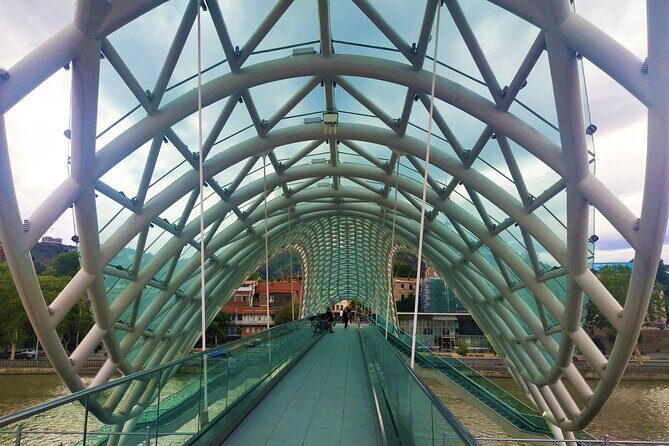
To wrap up, you’ll visit the Bridge of Peace and Rike Park. The bridge opened in 2010 and is 150 meters long, with a marine animal design. It was designed by Italian architect Michele De Lucchi, and the tour notes connect him with other Georgia government buildings, like the Presidential Palace and Ministry of Internal Affairs.
On this bridge, you can do an optional boat tour on the river Mtkvari for an additional charge. Even without the boat, the bridge is a nice visual break—clean lines, bright river views, and a sense of modern Tbilisi.
Then the tour includes a transfer to a luxury Georgian restaurant and museum setting, with traditional dancing and singing shows. It’s a chance to end the day with Georgia’s folk side, not just historic landmarks.
Time for the bridge itself is short (about 10 minutes), but the show part adds a memorable finish.
Consideration: show-based endings can run later than expected if the restaurant is busy. Wear shoes you can stand in.
Value check: is $147.50 a fair deal for this mix?
For $147.50, you’re buying three big things: time saved, transport comfort, and guided sequencing. You also get bottled water and alcoholic beverages, and wine tasting is included. Most major church and monument stops in the route are listed as free admission, which matters because free-entry sites often still eat your time when you’re trying to plan and travel between them.
You do have a couple of extras to expect:
- Funicular ride at Mtatsminda is not included (around $7).
- Lunch is mentioned as part of the day’s restaurant stop, but the pricing notes list lunch under not included. That’s the only “clarify with the operator” point on the list.
Even with those caveats, the schedule is packed in a way that suits a first-timer. You’ll cover the main cathedral, old churches, Narikala fortress views, and the Old Town core with enough structure that you’re not guessing where to go next.
This tour is especially good for:
- First-time visitors who want orientation in one day
- People who like scenery plus story (cathedrals, memorials, and viewpoints)
- Travelers who prefer private transportation over public transit
It’s less ideal for:
- Anyone who wants lots of unscheduled time to wander and choose their own pace
- Travelers who dislike stairs and uneven walking surfaces (Old Town is part of the plan)
- Strict budget travelers who don’t want any add-on costs
Practical tips to make the day smoother
A few simple moves can make the whole route feel easier.
- Bring a scarf and plan clothing for churches. Ladies need head scarves and dresses; men can’t wear short trousers. Scarves/dresses are available near church entrances.
- Wear shoes with traction. Old Town terrain and stairs are real, and you’ll walk more than you think.
- Carry a little cash for extras. The funicular isn’t included, and the boat tour is listed as an additional charge.
- If you have food needs, speak up early. The tour notes ask you to let them know about allergies or dietary restrictions so lunch can be adjusted.
- Expect the day to depend on weather. The tour is said to require good weather, which is crucial for viewpoint stops.
Should you book this Tbilisi city tour?
If you want a well-structured day that covers Tbilisi’s main sights without the stress of planning every leg, I think this is a solid choice—especially because you get wine tasting and strong viewpoint access to Narikala and the Mother of Kartli area.
But go in with two expectations: Old Town involves real walking, and there are a couple of potential add-ons (funicular, boat tour, and clarifying lunch). If you’re good with that, this is the kind of tour that gives you a fast, memorable map of Tbilisi for the rest of your trip.
FAQ
FAQ
What time does the tour start and how long does it last?
It starts at 9:00 am and lasts about 9 hours (approx.).
Is pickup included?
Yes, pickup is offered.
Is the tour conducted in English?
Yes, it’s offered in English.
What rides are included, and what costs extra?
The funicular ride at Mtatsminda Park is not included (around $7 per person). The aerial tramway/cable car segment involving the Mother of Kartli and Narikala is listed as included.
Is wine tasting included?
Yes, wine tasting with the meal is included as part of the day.
Is lunch included in the price?
The day includes a lunch stop, but the pricing notes also list lunch under not included. I’d confirm exactly what the cost covers with the operator before you go.
Do I pay admission for the churches and key sights?
Many major stops are listed as free admission. The funicular ride is the main listed paid add-on.
What should I wear for Orthodox churches?
Ladies need head scarves and dresses. Men should not wear short trousers. Scarves and dresses can be found near church entrances.
Can the tour accommodate dietary restrictions?
Yes. You should let the operator know about allergies or dietary restrictions so they can offer a suitable lunch option.